An awful lot has been said about OT's unsatisfying narrative structure,
about the clumsiness of its disjointed storytelling, about the asinine quality
of its writing. And, well, most of it is true: this is poor storytelling
we're dealing with indeed, and OT couldn't hold a candle to its
forebearers of Square and Enix fame even if its life depended on it. But on the
other hand, I daresay that it needn't hold a candle to said forebearers
in the narrative department, because it crushes them down when it comes
to all things fighting. Let's face it: OT's tentacular story is nothing
more than a pretense, a multipronged excuse to move your party around — and
engage in thousands of battles along the way. At its core, this game is all
about the fighting — nothing but the fighting. And boy, does it excel at
it indeed. OT simply boasts one of the best turn-based fighting systems
I've ever had the pleasure of handling, a system blessed with a depth I could
never, ever have suspected when I started playing. It takes a long time
to reveal its full potential — maybe a mite too long, actually; but if
you can soldier on until said potential unfolds, you're in for a real treat.
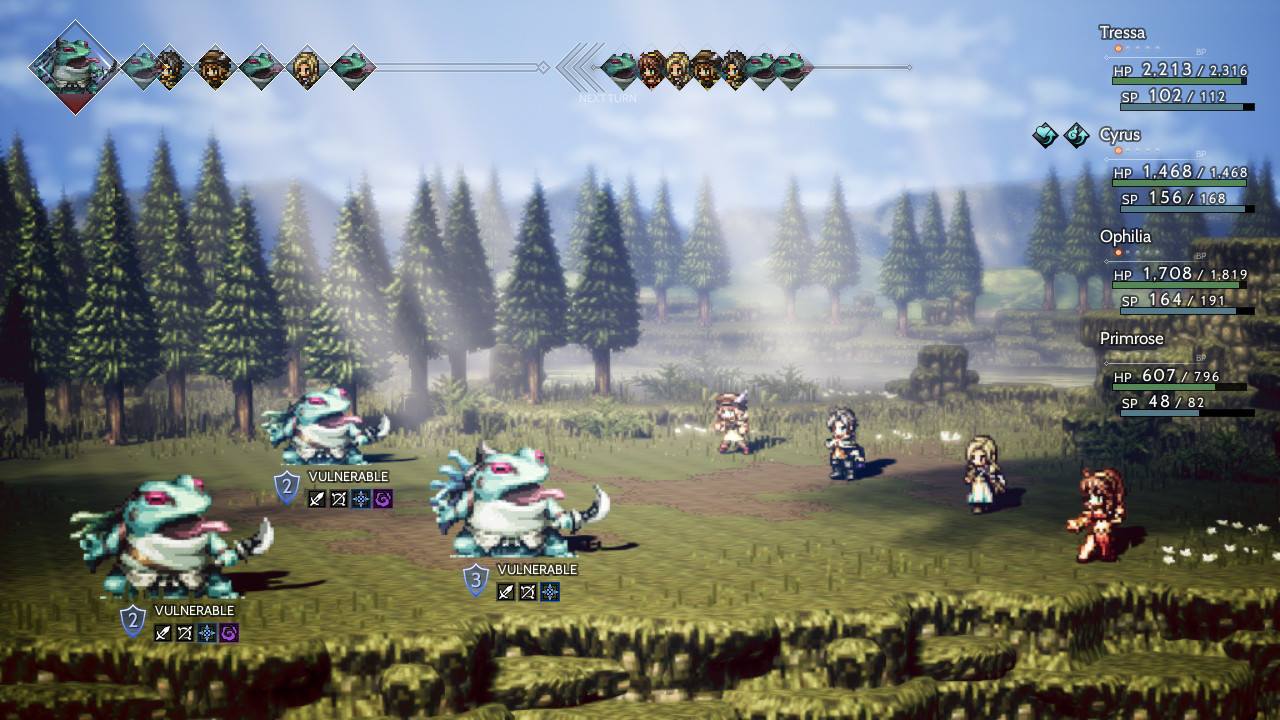
I'll admit it: I intensely disliked OT's fighting system at first. This
is a pretty grindy game we're dealing with; and as far as my RPG expectations
and experience are concerned, grindy games should go together with swift, easy,
promptly-polished-up random encounters. Which, oh dear, is so not the
case in OT. This is a game that makes you go all out and pull out the
stops in every single battle. Forget about spamming regular attacks and
mashing the A button to win: you'll need to think, strategize and, last but not
least, use skills like it's going out of fashion. Forget about brute-forcing
your way through with sheer overleveling: foes will remain a menace and a
challenge even when crawling fifteen levels below you. That's a very good
thing, of course; but I certainly didn't see it that way at first. Heck, I
didn't fancy at all being forced to give my full attention to every battle; I
nearly took it as a personal insult, and an undue attack on my precious time.
How dared that game make me toil on trash mobs like they were the local
boss, darn it? Also, thrifty little me balked at the thought of using
SP-consuming skills during random encounters, after a whole lifetime spent
saving such resources for boss fights. I very nearly quit right after
recruiting my fourth character, when a particularly buffed-up bunch of trash
mobs wiped the floor with my poor party. This is it, I thought; that's not what
I signed for, count me out.
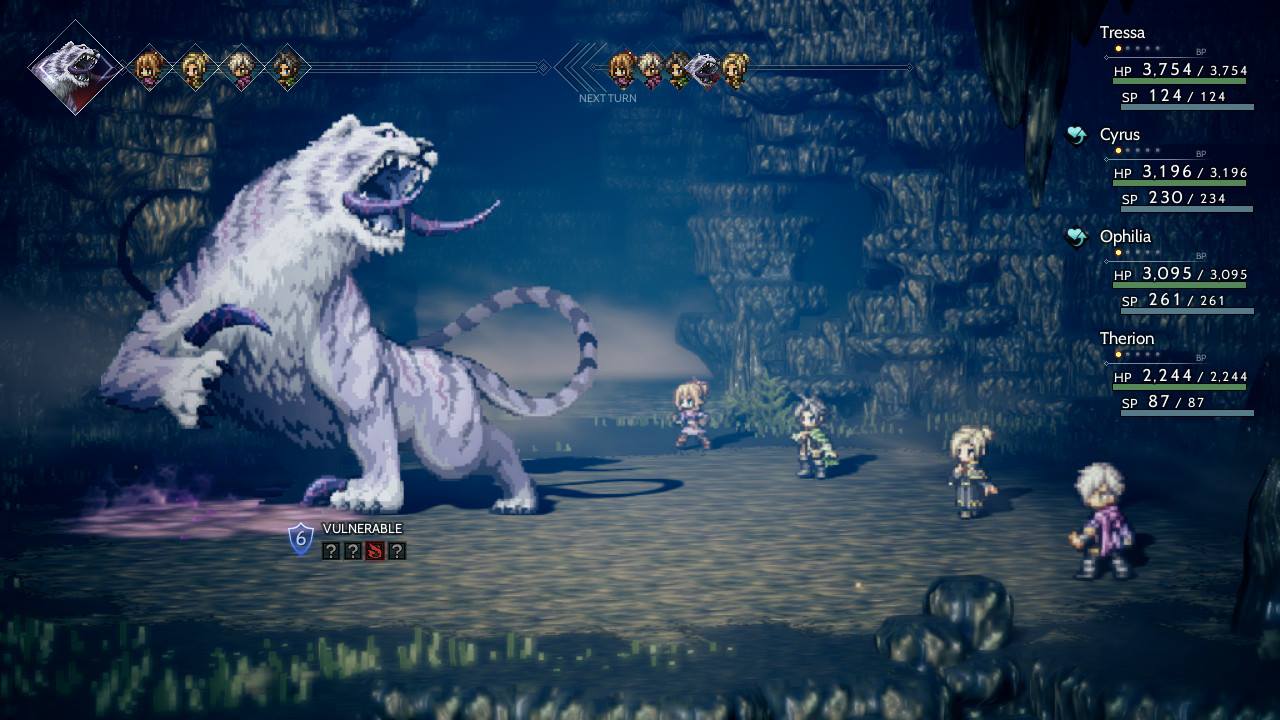
Of course, I didn't sign out, as you know already; I soldiered on, and soon
learnt to make the most of OT's fighting system. I learnt to use the
Break system to my advantage, swiftly and neatly erasing foes' turns to give
myself more leeway and opportunities to strike. I learnt to spend my SP wisely,
using fitting weapons and single-hit skills to Break the opposition first and
then pummeling my defenseless foes to death with multi-hit skills. I learnt to
study my opponents carefully instead of going straight for the attack command,
and I discovered the giddy joy of Breaking a round of foes in one turn through
the thought-out use of weapons and skills. I learnt to make the most of the
characters' natural complementarities, and to supplement them neatly with added
ones through the clever use of Secondary Jobs. I learnt all that and more, and
I enjoyed myself tremendously doing so. And then it dawned on me that OT's
fighting system is truly the stuff role-playing dreams are made off, with its
heavy emphasis on character complementarity and pitch-perfect use of weapons
and skills. That game elevates combat to an art form, daring you to wipe the
battlefield clean in the most efficient and elegant way with every single
battle.

I've been certainly doing my fair share of that in the last hours, especially
since I started dabbling in Secondary Jobs. I made Tressa a Thief, Cyrus an
Apothecary and Ophilia a Scholar, getting nearly full weapon and elemental
coverage in the process; the only attack type I'm still missing is Dark, but I
can make do without it. My calculations led me to the conclusion that there is
simply no way to get full weapon and elemental coverage with three party
members, no matter how you arrange Secondary Jobs. The game was obviously
designed with a party of four in mind — a party of four whose members are
switched on a regular basis to boot. I could totally ride fighting
complementarities much more than I currently do and design a tailor-made team
for every single area through job-switching; but I'm not sure I'll ever have
the courage to do that, all the less so as I've grown quite attached to my Trio
of Awesomeness already. On top of that, they are ridiculously oveleveled
compared to the rest of the crew, which doesn't make for slick fighting
dynamics; smoothing out those unbalances would require level-grinding, and I'd
rather eat my Switch than level-grind in OT. Guess I made my bed by
stubbornly sticking to the same three characters, and now I'll have to lie in
it — which I do kinda joyfully, given how much I love said three characters. But more on that very soon.
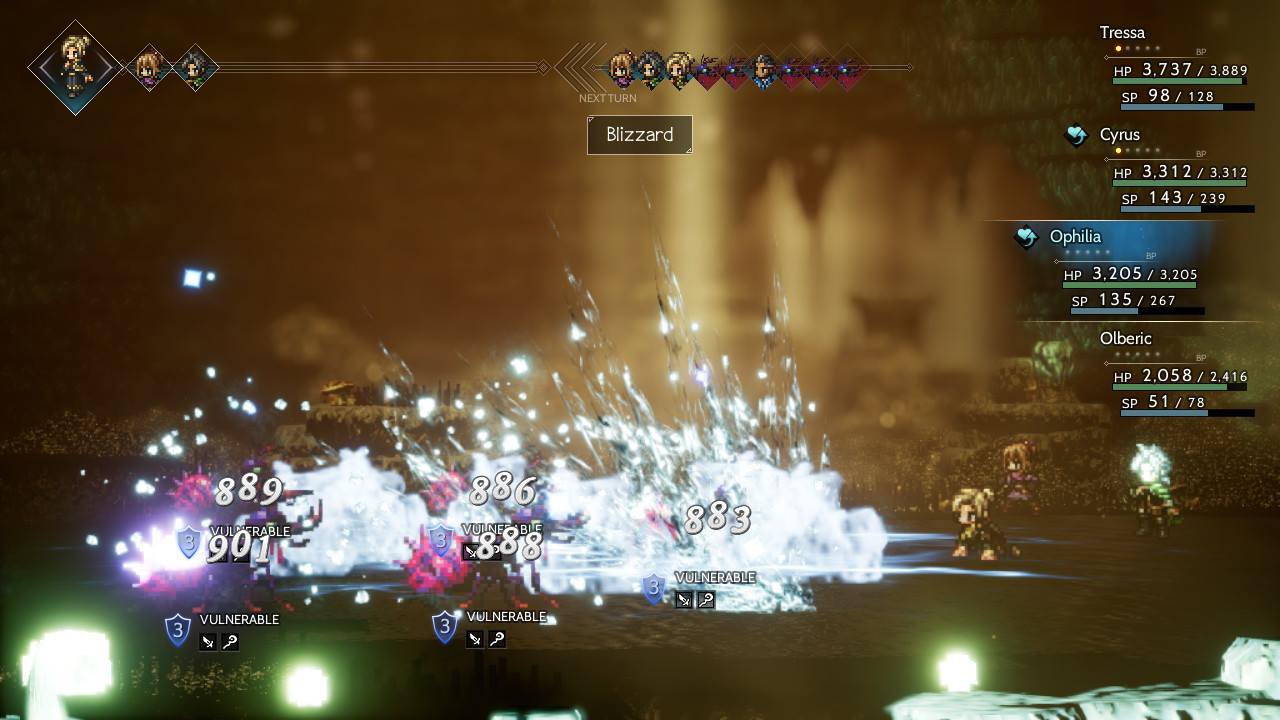
Here ends my ode to OT''s sheer brilliance and awesomeness in all things
fighting, dear fellow gamers. I'll see you soon with more tidings from
Orsterra; I'm nowhere near done with that game indeed, oh no precious. Thanks a
million for reading as usual, and drop by anytime!
No comments:
Post a Comment