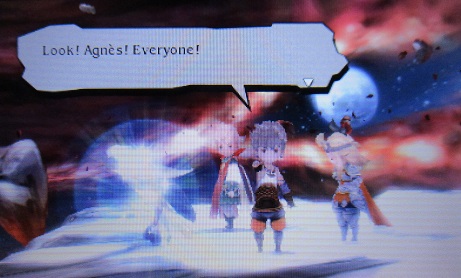
Let's face it: if Bravely Default's gameplay is
deeply fulfilling, its story is barely satisfactory. First, it is unnecessarily
convoluted and full of superfluous elements. Ringabel being an Alternis Dim
from another world who lost his memory in the tranfer? Unneeded, and probably
implemented solely to fill the amnesic character/evil twin quota. A version of
Agnes from yet another world popping up centuries in the past and being
referred to as a angel fallen from the skies? Unneeded as well, and sorely
confusing to boot. The story would have functioned just as well without these
two elements—and without a ton of others. Secondly, the storytelling is so
utterly messy, confusing and clumsy that following the story is more a trudge
than a delight. Thirdly, the meta premise of the player being cast as a being
from another dimension who enters the body of the main hero to help them save
the world is a trifle patronizing. Every RPG player with a bit of experience is
fully aware that they are projecting their own self into the main character(s)
and don't need to have that notion shoved down their throat by Square
Enix—like, "thank you, Captain Obvious". But not all is poorly told
and unconvincing: there are also some amazingly good bites in Bravely
Default's narrative—starting with the game's alternative ending, which I
would qualify as nothing less than an absolute stroke of genius.
Dubbed "Lying Airy", this ending is available from chapter 5 up until
the awakening of the ultimate crystal in chapter 8 and must be triggered by
disobeying Airy's instructions and shattering a crystal. This is achieved by
keeping on pressing the x button after Airy orders you to stop doing so, and
this maneuver can technically be performed on any crystal from chapter 5
onwards—although it's highly recommended to wait until chapter 7 or 8, since
the time needed to shatter a crystal is directly tied to the strength of your
party and thus to their levels.

The stroke of genius does not lie in this ending's
narrative content, which is hardly worth mentioning, but rather in the process
leading to its triggering. "Lying Airy" is not triggered by the
obtention of hidden flags or by a dialogue choice like most alternative
endings, but rather by a specific gameplay maneuver resulting from a conscious
choice made by the player. Shattering a crystal is never presented as a viable
alternative by the game; the possibilitity of doing so is only suggested through
hints and speculations uttered by the characters. Moreover, shattering a
crystal involves disobeying Airy's intructions, and scores of RPGs taught us
that we should not disobey guiding creatures that are kind enough to lend us a
hand in saving the world. The amount of scepticism and boldness required to
cross the Rubicon and disobey Airy is staggering, and yet it feels like a
perfectly natural thing to do thanks to the clever way the game brings the
matter.
The hint hidden in the title from chapter 6 onwards immediatetly comes to mind:
what a brilliant way to hint at the truth, bound to either arouse suspicions or
confirm them! Chapter 6 also sees the party mull over the situation and wonder
whether waking up the crystals is the right thing to do, whether Airy may have
ulterior motives and, most importantly, what would exactly happen if Agnès kept
pouring energy into a crystal until it shattered instead of stopping doing so
when Airy orders it. After that intense musing, they drop the subject and don't
mention it anymore in subsequent chapters. I first deemed this a serious
mishap, wondering why the story was not expanding on these suspicions; yet a
mishap this is not, but rather a brilliant narrative device. The characters are
not drawing conclusions from their abundant suspicions because it's up to the player
to do so themselves and act accordingly, in a vertiginous display of free
gaming will.

This is a pretty unique setup that I've never encountered in any other RPG,
at least not in such an achieved and polished form. A similar arrangement can
be found in Link's
Awakening, in which the
player follows the instructions of a helpful mysterious creature before a bunch
of hints arouses suspicions regarding the ultimate goal promoted by said
mysterious creature, which may not be as wholesome as it seemed at first sight.
The player can then exercise their free will and refuse to follow the
creature's instructions in order not to trigger a dramatic outcome. However,
that option is not a true choice but rather a defaulting of sorts that's not
planned by the game; as such, it doesn't lead to a specific ending, but rather
to an eternal statu quo. Bravely Default went much further than Link's
Awakening and enriched the mix with a specific gameplay action and a
dedicated ending, leading to a much more compelling result.
All in all, this alternative ending is absolutely brilliant, ingenious, clever
and whatever synonyms you can think of, so much so that it pretty much
single-handedly makes me forget the shortcomings of the narrative. I am utterly
grateful to Bravely Default for having treated me to such an original,
fresh and thrilling experience, and I can only hope that Bravely Second
will have similar delightful surprises in store. Thanks for reading, and be my guest anytime!
No comments:
Post a Comment